Choosing between a rollator vs. standard walker can be confusing, especially when you’re helping an older parent stay mobile and independent. Based on mobility guidance, manufacturer information, and practical differences between these walking aids, this guide explains which option may be safer and more comfortable for everyday use.
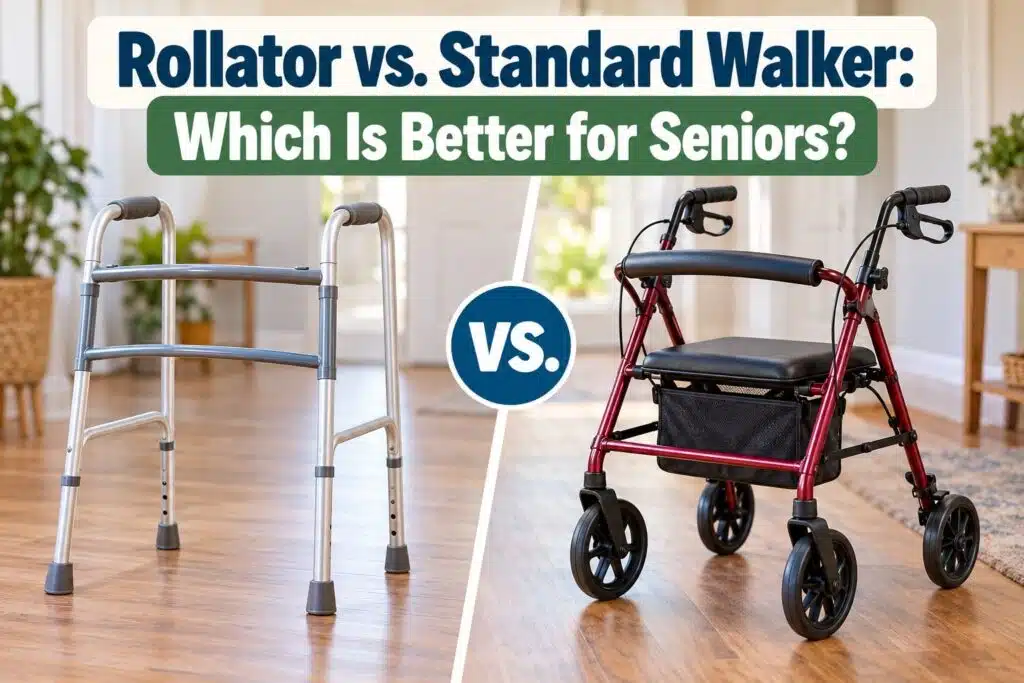
A standard walker provides a stable frame that you lift and reposition as you walk. A rollator has wheels, allowing you to move forward without lifting the frame with every step.
Both have advantages, but the right choice depends on your balance, strength, walking ability, and where you’ll use your mobility aid.
Rollator vs. Standard Walker: Quick Comparison
| Feature | Standard Walker | Rollator |
|---|---|---|
| Best for | Greater support and slower walking | Continuous walking with lighter support |
| Typical weight | Around 5–8 lbs | Around 12–25 lbs |
| Wheels | None | Usually 3 or 4 |
| Stability | Stationary when positioned correctly | Can roll if not controlled |
| Brakes | Not required | Hand-operated brakes |
| Built-in seat | No | Common on four-wheel models |
| Indoor use | Good on level floors | Good where space allows |
| Outdoor use | Less convenient on uneven surfaces | Often better on suitable outdoor paths |
| Portability | Usually lightweight and foldable | Often heavier, many fold |
| Price tier | Budget | Mid-range to premium |
Weights are approximate and vary between manufacturers and models.
A two-wheel walker offers another option for seniors who need more support than a rollator but find lifting a standard walker difficult.
What Is a Standard Walker?
A standard walker is a lightweight metal frame with four legs and rubber tips that grip the floor.
You hold the handles, lift the walker forward, place all four legs firmly on the ground, and step into the frame.
Unlike a rollator, a standard walker doesn’t move freely on wheels. This provides a stationary support base when all four legs are correctly positioned.
Standard walkers are commonly recommended for older adults who need greater support while walking, including some people recovering from surgery.
Benefits of Standard Walkers
One of the biggest advantages is stability.
Because there are no wheels, the walker stays stationary when placed correctly on a suitable surface.
I also like how simple the design is. There are no hand brakes to operate, wheels to control, or complicated features to learn.
Most standard walkers are relatively lightweight and can fold for storage or transportation.
They’re generally more affordable than four-wheel rollators, making them an accessible option for seniors on a limited budget.
Disadvantages of Standard Walkers
The biggest drawback is having to lift the walker repeatedly.
For seniors with arthritis, painful shoulders, or limited upper-body strength, this can become tiring.
Standard walkers also interrupt your natural walking rhythm. You must stop, reposition the frame, and then move forward.
They’re less convenient for longer outdoor walks and uneven ground.
Another limitation is the lack of a built-in seat. If you need frequent rest breaks, you’ll have to find somewhere suitable to sit.
Who Should Consider a Standard Walker?
A standard walker may suit seniors who:
- Need firm support when walking.
- Move slowly over short distances.
- Have significant balance difficulties.
- Can lift and reposition the frame safely.
- Need a walking aid during rehabilitation, following professional advice.
A physical therapist should assess whether a standard walker provides the right level of support.
What Is a Rollator Walker?
A rollator is a wheeled walking aid designed to help people move more continuously.
Most four-wheel rollators include hand brakes, adjustable handles, a seat, and a storage pouch or basket.
Rather than lifting the device with every step, you push the rollator forward while walking.
This makes rollators popular among seniors who can walk with relatively light support but appreciate assistance with balance and mobility.
Benefits of Rollator Walkers
The main advantage is easier movement.
You don’t need to lift the entire frame repeatedly, which may reduce fatigue during longer walks.
Many four-wheel rollators also include a built-in seat.
This is particularly useful for seniors who need occasional rest breaks while shopping or walking outdoors.
Other benefits include:
- Smoother walking on suitable surfaces.
- Adjustable handle heights.
- Folding designs for transportation.
- Storage compartments for small belongings.
- Larger wheels on some outdoor models.
For someone who enjoys regular walks but tires easily, a rollator with a seat can be a practical option.
Disadvantages of Rollator Walkers
Rollators aren’t suitable for everyone.
Because the wheels move freely, the device can roll forward unexpectedly if you lean too heavily against the frame.
Hand brakes also require sufficient grip strength and coordination.
This can create difficulties for seniors with painful hands, severe arthritis, or limited dexterity.
Four-wheel rollators are often heavier and bulkier than standard walkers.
They may also be awkward to maneuver through narrow hallways and small bathrooms.
Another concern is the seat. You must engage the parking brakes before sitting, and ordinary rollators shouldn’t be used to transport someone while seated.
Who Should Consider a Rollator?
A rollator may suit seniors who:
- Can walk with relatively light support.
- Have sufficient balance to control a wheeled device.
- Can operate hand brakes reliably.
- Enjoy outdoor walks or shopping trips.
- Need occasional seated rest breaks.
- Want a walking aid that moves without repeated lifting.
Rollators aren’t generally appropriate for someone who needs to place substantial body weight through the frame while walking.
Standard Walker vs. Two-Wheel Walker vs. Rollator
There’s another option worth considering: the two-wheel walker.
A two-wheel walker has wheels at the front and rubber tips or suitable glides at the back.
You can move the frame forward without lifting the entire walker.
This design may suit seniors who struggle to lift a standard walker but need more controlled support than a four-wheel rollator provides.
| Walking Aid | Main Advantage | Main Limitation |
|---|---|---|
| Standard walker | Firm, stationary support | Requires lifting |
| Two-wheel walker | Less lifting while walking | Rear legs can drag or catch |
| Four-wheel rollator | Continuous movement and a seat | Requires brake control |
| Three-wheel rollator | Easier maneuvering in narrow spaces | Usually no seat and a smaller support base |
Three-wheel rollators can be convenient in smaller homes, but their narrower design isn’t automatically safer than a four-wheel model.
[INTERNAL LINK: How to Choose the Right Walker for an Elderly Person]
How to Choose the Right Walker for Seniors
Before choosing a mobility aid, focus on how the person walks, how much support they need, and where they’ll use the device.
Balance and Stability
Balance should be your first consideration.
If you frequently lose your balance, struggle to remain upright, or need substantial support through your arms, a standard or two-wheel walker may be more suitable.
Rollators generally work better for people who can maintain their balance while walking and need lighter assistance.
If you’ve experienced recent falls, ask a physical therapist to assess your walking ability before choosing a device.
Upper-Body Strength and Hand Grip
Standard walkers require enough arm strength to lift and reposition the frame.
Rollators reduce repeated lifting, but users need enough grip strength and coordination to operate the brakes.
For seniors with arthritis, both designs have limitations.
Painful shoulders can make lifting a standard walker uncomfortable, while stiff fingers may make rollator brakes difficult to operate.
Trying both types under professional supervision can help you find a suitable option.
Walker Height and Handle Position
A walker that’s too high or too low can encourage poor posture and make walking more difficult.
A common starting point is to stand upright in your usual walking shoes with your arms relaxed at your sides.
The handles should sit approximately level with your wrist creases, allowing a slight bend in your elbows when gripping them.
A physical therapist can confirm the correct height for your posture and mobility needs.
Wheel Size and Floor Surfaces
Wheel size matters if you’re considering a rollator.
Smaller wheels can work well on smooth indoor floors.
Larger wheels may move more easily over suitable outdoor paths and minor pavement irregularities.
But no rollator is suitable for every surface.
Loose gravel, steep slopes, broken pavement, and slippery paths can still create hazards.
Weight and Folding Mechanisms
Think about who will carry the walking aid or lift it into a car.
Standard walkers are usually lighter than four-wheel rollators.
Many rollators fold for storage, but some remain fairly heavy even when folded.
Check the actual product weight rather than relying on descriptions such as lightweight or portable.
Seat and Storage Features
A seat is one of the biggest reasons people choose a four-wheel rollator.
For seniors who tire easily, having somewhere to rest can make longer outings more manageable.
Check the manufacturer’s seat dimensions and weight capacity before buying.
Storage compartments are convenient, but avoid overloading them.
Heavy bags can affect how a rollator handles and increase the risk of tipping.
Which Is Safer for Seniors With Balance Problems?
A standard walker generally provides more stationary support than a rollator.
The four rubber-tipped legs create a stable base when positioned correctly on suitable flooring.
A rollator moves on wheels, so users must maintain control of the device while walking.
According to the American Academy of Family Physicians, standard walkers offer greater stability but require more strength and coordination to lift.
When a Standard Walker Is Safer
A standard walker may be more appropriate if you:
- Need substantial support while walking.
- Have significant balance problems.
- Move slowly over short distances.
- Need a stationary frame for support.
- Can safely lift and reposition the walker.
If lifting the frame causes problems, a two-wheel walker may be worth discussing with a physical therapist.
When a Rollator Is Safer
A rollator may be suitable if you:
- Can walk with lighter support.
- Maintain reasonable balance while moving.
- Can control the wheels and brakes.
- Need help maintaining a comfortable walking rhythm.
- Benefit from occasional rest breaks.
Don’t assume that a rollator is safer simply because it has four wheels and a seat.
The safest device is the one that matches your individual walking ability.
Which Is Better for Indoor and Outdoor Use?
Your home and regular walking routes should influence your decision.
Standard Walkers for Indoor Use
Standard walkers can work well for short distances around the home.
Their rubber-tipped legs provide support on suitable level flooring.
Many models are narrow enough to fit through ordinary doorways.
Small bathrooms can still be awkward, particularly if there isn’t enough space to lift and turn the frame.
Measure your narrowest doorways and hallways before buying.
Rollators for Outdoor Use
Rollators designed for outdoor use are generally more convenient for longer walks.
Larger wheels can handle minor pavement irregularities more comfortably.
A built-in seat also provides somewhere to rest during outings.
For someone who regularly visits local parks or shops, a suitable four-wheel rollator may be more practical than a standard walker.
Avoid steep slopes and unstable surfaces unless a healthcare professional has confirmed they’re safe for you.
Which Is Better for Small Homes?
A folding standard walker may be easier to store in a small apartment.
Three-wheel rollators can maneuver through narrow spaces more easily than many four-wheel models.
But their smaller support base may be unsuitable for someone with significant balance difficulties.
Always check the product’s overall width and turning space before ordering.
Rollator vs. Standard Walker After Surgery
Following hip, knee, or other lower-limb surgery, your walking aid should match your surgeon’s weight-bearing instructions.
A standard or two-wheel walker is often recommended during early rehabilitation because these devices can provide more controlled support.
A rollator may be unsuitable if you need to keep substantial weight off an injured or operated leg.
As your strength and mobility improve, your physical therapist may recommend changing to a different walking aid.
Don’t make that change without professional advice.
Common Walker and Rollator Safety Mistakes
Even a suitable walking aid can become hazardous when used incorrectly.
Using the Wrong Height
Handles that are too low can encourage bending forward.
Handles that are too high can make the frame difficult to control.
Have your walking aid adjusted correctly before regular use.
Walking Too Far Behind the Frame
Keep your body appropriately positioned within the walker or rollator.
Pushing a rollator too far ahead can encourage leaning forward and reduce control.
The Cleveland Clinic’s walker guidance explains correct fitting and walking techniques.
Forgetting to Lock Rollator Brakes
Always engage the parking brakes before sitting on a rollator seat.
Check that the wheels remain stationary before lowering yourself onto the seat.
Don’t use an ordinary rollator as a wheelchair unless the manufacturer specifically approves that function.
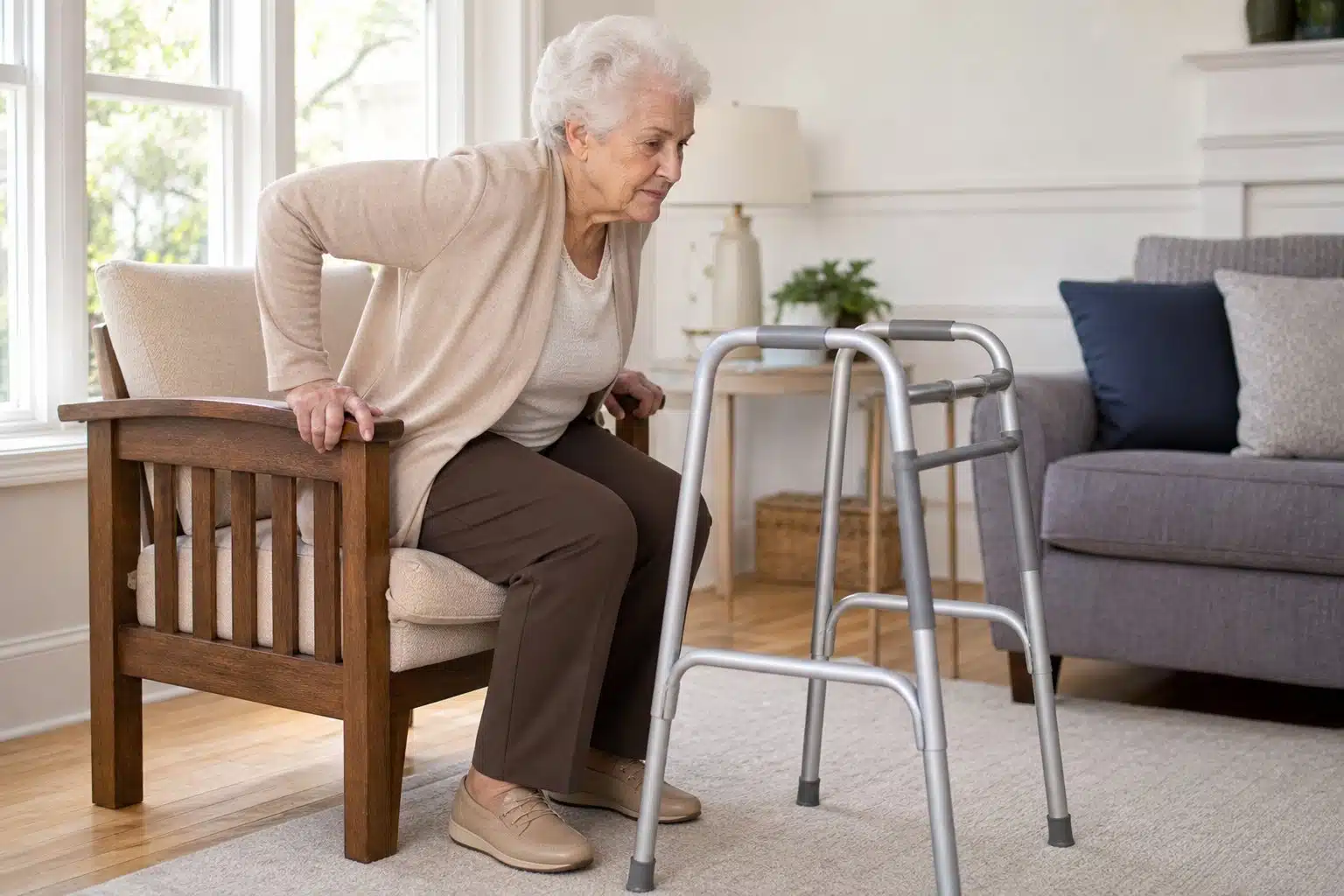
Pulling on a Walker to Stand Up
Avoid pulling yourself upright using an ordinary walker.
The frame may tip or move.
Instead, push up from a stable chair’s armrests or another approved support, then take hold of the walker once you’re balanced.
Ignoring Worn Parts
Inspect rubber tips, wheels, handles, folding locks, and brakes regularly.
Replace worn rubber tips and arrange repairs if the brakes aren’t working correctly.
A damaged walking aid should be repaired or replaced before further use.
Carrying Heavy Shopping Bags
Avoid hanging heavy shopping bags from the handles.
Extra weight can affect balance and increase the risk of tipping.
Use manufacturer-approved storage compartments and follow their weight limits.
[INTERNAL LINK: Home Safety Checklist for Seniors]
Which One Should You Buy?
I’d narrow the decision down to four common situations.
Best for Seniors Who Need Maximum Stability
Choose a standard walker if you need a stationary support frame, can lift and reposition the device safely, and mainly walk short distances.
Its simple design makes it a sensible option for people who need greater walking support.
A physical therapist should confirm that the device provides enough stability for your needs.
Best for Active Seniors Who Need Rest Breaks
Consider a four-wheel rollator if you can walk with lighter support and operate the brakes safely.
A seat and smoother rolling movement can make shopping trips and neighborhood walks more manageable.
I’d prioritize reliable brakes, comfortable handles, and suitable wheels over extra accessories.
Best for Seniors With Limited Upper-Body Strength
A two-wheel walker deserves consideration if lifting a standard walker becomes tiring.
The front wheels reduce the need to lift the frame, while the rear legs maintain contact with the floor.
For someone who needs greater support but struggles with a standard walker, this may be a useful compromise.
Best for Seniors on a Tight Budget
Standard walkers are generally the more affordable choice.
They also have fewer moving parts that require maintenance.
But price shouldn’t determine your choice if another device provides more appropriate support.
A mobility assessment can help you avoid spending money on an unsuitable walker.
Common Questions
Is a Rollator Better Than a Walker for Seniors?
A rollator can be better for seniors who walk with lighter support and want easier movement over longer distances. A standard walker generally provides more stationary support for people with greater balance or weight-bearing needs.
Can You Lean Your Full Weight on a Rollator?
An ordinary rollator isn’t designed for someone who needs to place substantial body weight through the frame while walking. If you require significant weight-bearing assistance, ask a physical therapist about a standard walker or another suitable mobility aid.
Which Walker Is Best for Elderly People With Weak Legs?
The answer depends on the amount of support required and the person’s ability to control the device. A standard or two-wheel walker may be more suitable than a rollator when leg weakness affects balance or weight-bearing ability.
Are Four-Wheel Rollators Safer Than Three-Wheel Rollators?
Four-wheel rollators generally have a wider support base and often include a seat. Three-wheel designs can be easier to maneuver in tight spaces, but the safest choice depends on your balance, strength, and surroundings.
Can Seniors Use a Rollator Inside the House?
Yes, provided the rollator fits through doorways and has enough room to turn safely. Narrow hallways, thick rugs, clutter, and small bathrooms can make some models difficult to use.
Final Recommendation
For seniors who need firm, stationary support, I’d generally favor a standard walker, provided they can lift and use the frame safely.
For older adults who can walk with lighter support, operate hand brakes, and appreciate occasional rest breaks, a four-wheel rollator is often more practical.
And for anyone who struggles to lift a standard walker but still needs controlled support, a two-wheel walker deserves consideration.
The safest choice isn’t necessarily the lightest, most expensive, or most feature-packed model. It’s the walking aid that matches your actual mobility needs.
If you’re buying for an elderly parent, consider arranging a physical therapy assessment before making a final decision, especially if they’ve experienced recent falls or have difficulty bearing weight.
[INTERNAL LINK: How to Choose the Right Walker for an Elderly Person]
Sources and Further Reading
- American Academy of Family Physicians: Mobility Assistive Device Use in Older Adults. Clinical guidance on walking aids, stability, and choosing suitable mobility equipment.
- Cleveland Clinic: How to Use a Walker. Walker fitting, walking techniques, and safety advice.
- Guy’s and St Thomas’ NHS: Staying Active and Preventing Falls. General guidance on mobility and reducing fall risks.
- Medline: Rollator User Instructions. Manufacturer guidance on rollator brakes, seating, and safe operation.