
Using a Walker Safely Around the House
Knowing how to use a walker safely around the house matters because most walker falls happen during short, everyday moves at home, not on long walks.
Turning at the kitchen counter, squeezing through a bathroom door, backing up to a chair or carrying a cup of tea from one room to another are the moments when balance is most often lost.
This guide brings together advice from hospital discharge instructions, physical therapy guidance from sources such as the Cleveland Clinic, and the everyday experience of walker users and their families. It covers fit, technique, room-by-room setup and simple ways to keep both hands on the frame.
- Check the fit before anything else
- The correct walking pattern indoors
- Turning, doorways and tight spaces
- Sitting down and standing up safely
- Carrying things without letting go
- Setting up each room for walker use
The Short Version
- Fit first Handles should sit level with the wrist crease when arms hang relaxed, giving about a 15 to 20 degree bend at the elbow.
- Stay inside the frame Step into the walker, not up to it. Pushing it too far ahead is one of the most common causes of a stumble.
- Never pull up on it Use the armrests of a sturdy chair to stand and sit. A walker can tip or roll if you pull or push down on it.
- Keep hands free Carry items in a walker bag, basket or tray instead of in your hands.
- Clear the route Loose rugs, cords, clutter and dim lighting cause more walker trips than the walker itself.
Learning to use a walker safely takes practice. Ask a physical or occupational therapist to check your technique at home if you can.
Why It Matters to Use a Walker Safely at Home
Learning to use a walker safely is one of the most practical things an older adult can do to stay independent at home. A walker widens your base of support and takes weight off painful or weak legs, but it only protects you when it is the right size and used the right way.
Falls are common in later life. The National Institute on Aging reports that more than one in four people aged 65 or older fall each year, and it notes that using canes and walkers correctly can help prevent falls. A walker that is the wrong height, has worn tips or is pushed too far ahead can do the opposite and make a stumble more likely.
Most of the risk sits in ordinary moments: getting up from the sofa, turning at the sink, or heading to the bathroom at night. That is why this guide focuses on how to use a walker safely during everyday tasks rather than on long walks outdoors. Good walker safety at home starts with the basics: the right fit, the right technique and a clear route.
Check the Walker Fits Before You Use It
Before you can use a walker safely, it has to fit you. A walker that is too high makes you shrug and lose leverage. One that is too low makes you stoop, pushing your weight forward and towards a fall. Both are surprisingly common, especially with second-hand walkers or ones adjusted once in hospital and never checked again.
Stand upright inside the frame wearing your usual indoor shoes, with your arms relaxed at your sides. The handgrips should line up with the crease of your wrist. When you hold them, your elbows should bend slightly, roughly 15 to 20 degrees. The Cleveland Clinic's walker guidance recommends checking the height while wearing the shoes you normally walk in.
Also check that all legs are set to the same height, the push buttons have fully clicked into their holes, and the rubber tips or glides are not worn smooth. For a full walkthrough, see How to Measure a Walker for the Correct Height.
If the walker was not fitted by a physical therapist or occupational therapist, it is worth asking for one. They can also watch you walk at home and spot habits that are hard to notice yourself.
How to Use a Walker Safely: The Correct Walking Pattern
- Move the walker first
Place it about one small step ahead, roughly an arm’s length or less. A standard walker is lifted and set down; a two-wheeled walker is slid forward. Wait until all four legs are on the floor.
- Step in with the weaker leg
If one leg is weaker or recovering from surgery, step it forward first so its foot lands roughly in the middle of the frame.
- Follow with the stronger leg
Bring the stronger leg level with the weaker one. Your body should end up inside the frame, not behind it.
- Stand tall and look ahead
Keep your back upright and your eyes a few steps ahead rather than on your feet. Looking down pulls your weight forward.
- Repeat slowly
Use a steady rhythm. Rushing is how the walker ends up too far ahead and the feet get left behind.
Do not lift a walker that has wheels, and do not push a walker that only has rubber feet. Using the wrong motion is a common reason walkers feel unstable.

How to Use a Walker Safely With a Standard or Two-Wheeled Frame
The technique changes slightly with the type of walker. A standard walker has four rubber-tipped legs. Lift it, set all four legs down about one small step ahead, then step in. Never slide it, because the rubber tips grip the floor and the frame can jerk to a stop.
A two-wheeled walker has wheels on the front legs and glides or tips on the back. Push it forward smoothly without lifting it, keep your weight balanced between your hands and feet, and stay close to the frame. MedlinePlus advises that all four tips or wheels should be on the ground before you put weight on the walker.
If you are unsure which type suits your home, see How to Choose the Right Walker for an Elderly Person.
Turn, Reverse and Get Through Doorways Safely
Turning is where many walker users lose balance, because it's tempting to twist the upper body while the feet stay planted. To use a walker safely in tight spaces, slow down and let your feet do the turning.
Turning: Take several small steps around in a gradual arc, turning the walker with you as you go. Keep the frame in front of you the whole time and avoid pivoting on one foot.
Backing up: Only step backwards when you need to line up with a chair or bed. Take small steps, glance behind you first and keep going slowly.
Push-open doors: UMass Memorial's discharge instructions suggest this method: Get close, push the door open firmly, then move the walker into the doorway so the frame holds the door while you step through.
Pull-open doors: Keep one hand on the walker, pull the door towards you with the other, and position the walker in the opening to keep it from swinging shut.
Thresholds: Approach raised door thresholds straight on, not at an angle. With a standard walker, lift it fully over the edge rather than dragging it. If a threshold is high enough to catch the legs regularly, a threshold ramp is usually a simple fix.
If your walker only just fits through the bathroom or bedroom door, every visit becomes a balance challenge. Consider rearranging furniture, removing a door, or using a narrower frame. Our guide to narrow walkers for small apartments compares slimmer options.
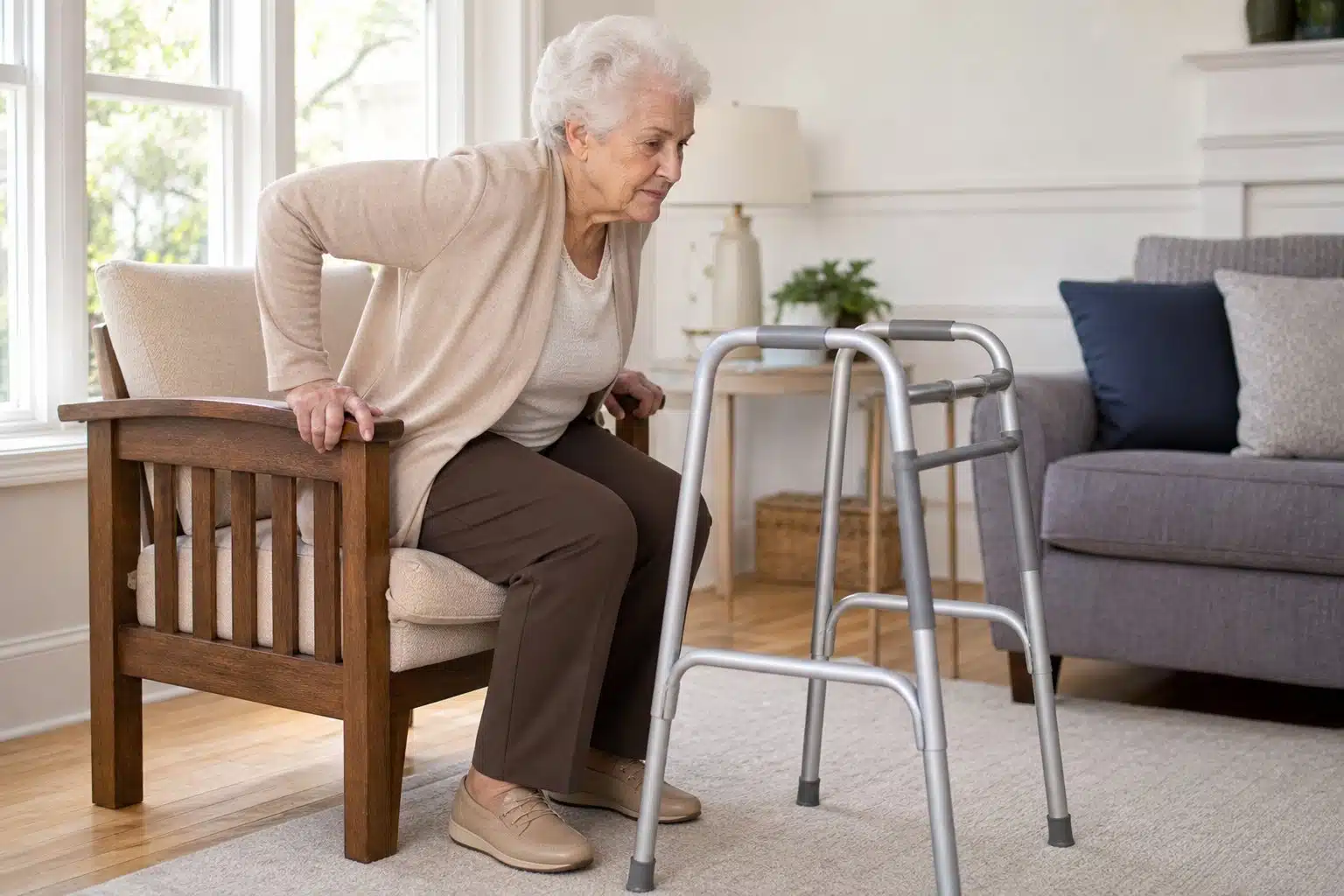
Sit Down and Stand Up Without Using the Walker as a Lever
-
Back up until you feel the seat
Walk towards the chair, turn with small steps, then back up until the seat touches the backs of both legs.
-
Reach back for the armrests
Let go of the walker one hand at a time and reach for the chair’s armrests. If you have a weaker leg, slide it slightly forward.
-
Lower yourself slowly
Bend at the hips and knees and sit down in a controlled way. Don’t drop into the seat.
-
To stand, scoot forward first
Shift to the front edge of the seat, place your feet slightly apart and push up from the armrests, not the walker.
-
Pause, then take the handles
Once upright, wait a moment for your balance to settle and any dizziness to pass, then take hold of the walker grips.
Pulling up on a walker is the single most common misuse physical therapists warn about. The frame isn’t anchored, so it can tip back towards you or roll away. Chairs with firm seats and solid armrests make this much easier than soft, low sofas.

Carry Things Without Letting Go of the Frame
Carrying a plate, a phone or a drink is one of the main reasons people let go of their walker mid-step. Others hook shopping bags over the handles, which shifts the weight and can make the walker tip forward. To use a walker safely, both hands need to stay on the grips.
There are a few simple ways to carry things instead:
- Walker bags and pouches attach to the front crossbar and suit small essentials such as a phone, glasses, tissues or the TV remote.
- Baskets hold their shape better than soft bags, making items easier to reach without bending.
- Walker trays give a flat surface for meals and drinks. Trays with cup holders and a non-slip surface keep things from sliding, and see-through trays let you watch the floor directly ahead.
- Lidded travel mugs stop hot drinks from spilling while you walk.
- Clothing with pockets, an apron, a cross-body bag or a small backpack keep things off the walker altogether.
Keep loads light. Hospital guidance is clear that a walker is not designed to carry heavy items, and a heavy load at the front changes how the frame balances.
Walker users often report that baskets and trays made for standard folding walkers don’t fit rollators, and that soft bags can sag and rub against the front legs. Measure the width of your walker’s front crossbar and check that any carrier sits clear of your legs and the wheels.
Set Up Each Room for Walker Use
Even perfect technique won't help if the walker keeps catching on rugs or bumping into furniture. According to the CDC's older adult falls data, about 1 in 4 older adults report falling every year, and falls are the leading cause of injury for adults aged 65 and older.
To use a walker safely in every room, walk your usual daily routes, such as bedroom to bathroom, chair to kitchen and front door to living room, and look at them from the walker's point of view.
What a Walker-Friendly Home Looks Like
Walker legs and wheels catch easily on rug edges, and tennis balls or worn tips can drag on carpet.
The walker needs a path wider than its frame, with space to turn at each end.
Power cords and items on the floor are easy to miss when you’re watching the frame.
Night-time trips to the bathroom are a high-risk moment for walker users.
Walkers are often too wide to use right up to the toilet or shower.
Working at the counter tempts people to let go of the walker.

Stairs need a different plan. Most walkers are not designed for stairs, so if there are steps in the home, ask a physical therapist about a safe method and consider a second walker for each floor. See How to Make Stairs Safer for Elderly Adults and How to Prevent Falls at Home for Seniors for broader home changes.
How to Use a Walker Safely at Night
Night-time trips to the bathroom combine low light, grogginess and sometimes urgency, which is why they are one of the riskiest times for walker users. A few habits make a big difference to walker safety at home after dark.
Keep the walker within reach of the bed so you never have to walk without it. Sit on the edge of the bed for a moment before standing so any dizziness can pass. Turn on a light, or use motion-sensor night lights along the route, before you start walking.
Keep the path from bed to bathroom completely clear and wear slippers with a closed back and a non-slip sole rather than socks. If night-time trips are frequent, talk to a doctor, since some medicines and health conditions increase the need to get up at night. Our guide to improving home lighting to reduce fall risks covers lighting in more detail.
Common Walker Mistakes at Home
The further ahead the walker is, the more you lean forward and the less it supports you. Keep it about one small step in front.
Leaning forward moves your weight past your feet, which is a common way walker users stumble.
Walkers aren’t fixed to the floor and can tip back or roll. Push up from the chair’s armrests instead.
This is one of the most frequent misuses physical therapists see.
Tennis balls work, but they wear quickly, collect dirt and can drag on carpet. Purpose-made skis or glides usually last longer and slide more evenly.
Worn or sticky glides make the walker jerk, which can throw off your balance.
Many falls happen during short moves such as going to the toilet at night or crossing to the kitchen. If the walker was recommended, use it for every trip.
Leaving the walker behind “just this once” is one of the most common stories behind a fall at home.
Walker Safety at Home: When to Ask for Professional Help
Good walker safety at home is not only about technique. Ask a doctor, physical therapist or occupational therapist for help if the walker feels unsteady, if you have had a fall or near miss, or if you find yourself holding furniture instead of the frame.
A therapist can check the height, watch how you use a walker in your own rooms, show you how to use a walker safely on your own routes and suggest changes such as a different walker type, grab bars or rearranged furniture. The National Institute on Aging also recommends having a health care provider check any borrowed walking equipment to make sure it is the right size and safe to use.
Getting help early is a sign of good planning, not of losing independence. Small adjustments now can prevent a fall that would be much harder to recover from.
Frequently Asked Questions
How do I use a walker safely at home?
Make sure the handles are at wrist height, move the walker about one small step ahead, step in with the weaker leg and then the stronger leg, and keep your body inside the frame. Turn with small steps, use chair armrests to sit and stand, and keep floors clear of rugs, cords and clutter.
Should I use my walker inside the house?
Yes, if a doctor or therapist recommended one. Most walker-related falls happen at home during routine moves, so using it indoors matters as much as using it outside.
How far in front of me should the walker be?
About one small step, roughly an arm’s length or less. You should be able to step into the frame so your body ends up between the back legs.
Can I use a walker on carpet?
Yes, but low-pile carpet is easier than deep pile. Two-wheeled walkers with skis or glides on the back legs usually move more smoothly on carpet than walkers with rubber tips.
Is it safe to carry a drink while using a walker?
Not in your hand. Use a walker tray with a cup holder or a lidded travel mug in a walker bag so both hands stay on the grips.
What if my walker doesn't fit through the bathroom door?
Measure the doorway and the walker. Options include removing the door, fitting offset hinges to gain an inch or two, or using a narrower walker. Avoid turning sideways and shuffling through, which is unstable.
Should I use my walker on the stairs?
No, not unless a physical therapist has taught you a specific method. Use the handrail and, if you live on two floors, consider keeping a walker on each level.
How often should I check my walker?
Give it a quick look every week: push buttons fully engaged, legs the same height, grips secure and tips or glides not worn. Replace worn rubber tips promptly.
Final Thoughts
- Check handle height and leg locks before regular use
- Move the walker, step in with the weaker leg, then the stronger leg
- Turn in small steps and use the frame to hold doors open
- Use chair armrests, never the walker, to sit and stand
- Clear rugs, cords and clutter from daily routes
Learning to use a walker safely around the house comes down to three things: a walker that fits, a steady technique that keeps you inside the frame, and a home that gives the walker room to move. Small habits like pushing up from the chair rather than the walker and carrying things in a bag instead of your hands remove many everyday fall risks.
This guide is for general information and is not a substitute for advice from a doctor, physical therapist or occupational therapist who knows your health and home.