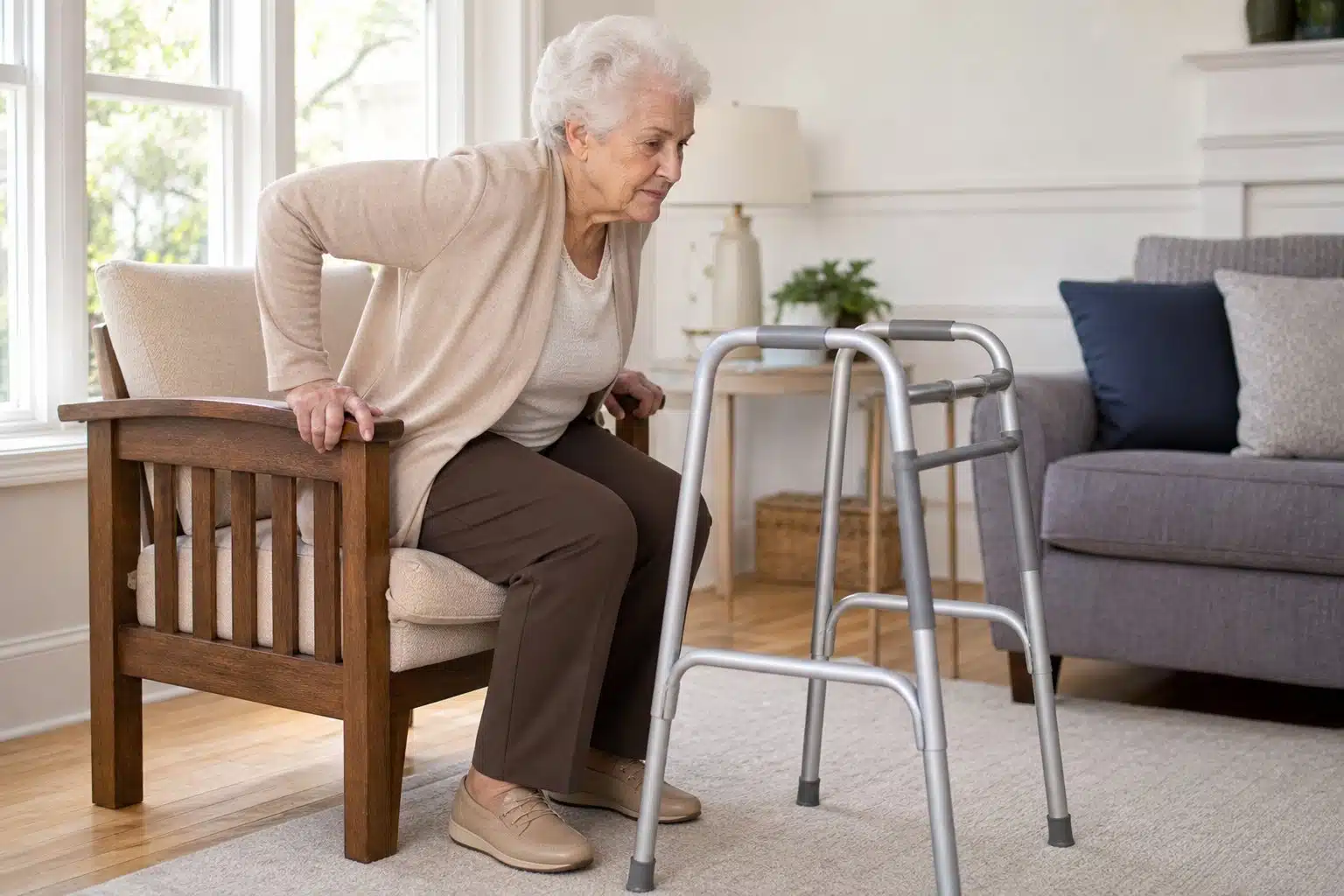
Choosing between a shower chair vs transfer bench can make a real difference to bathroom safety, particularly for seniors with balance problems, weak legs or limited mobility.
Both provide somewhere to sit while bathing, but they solve different problems.
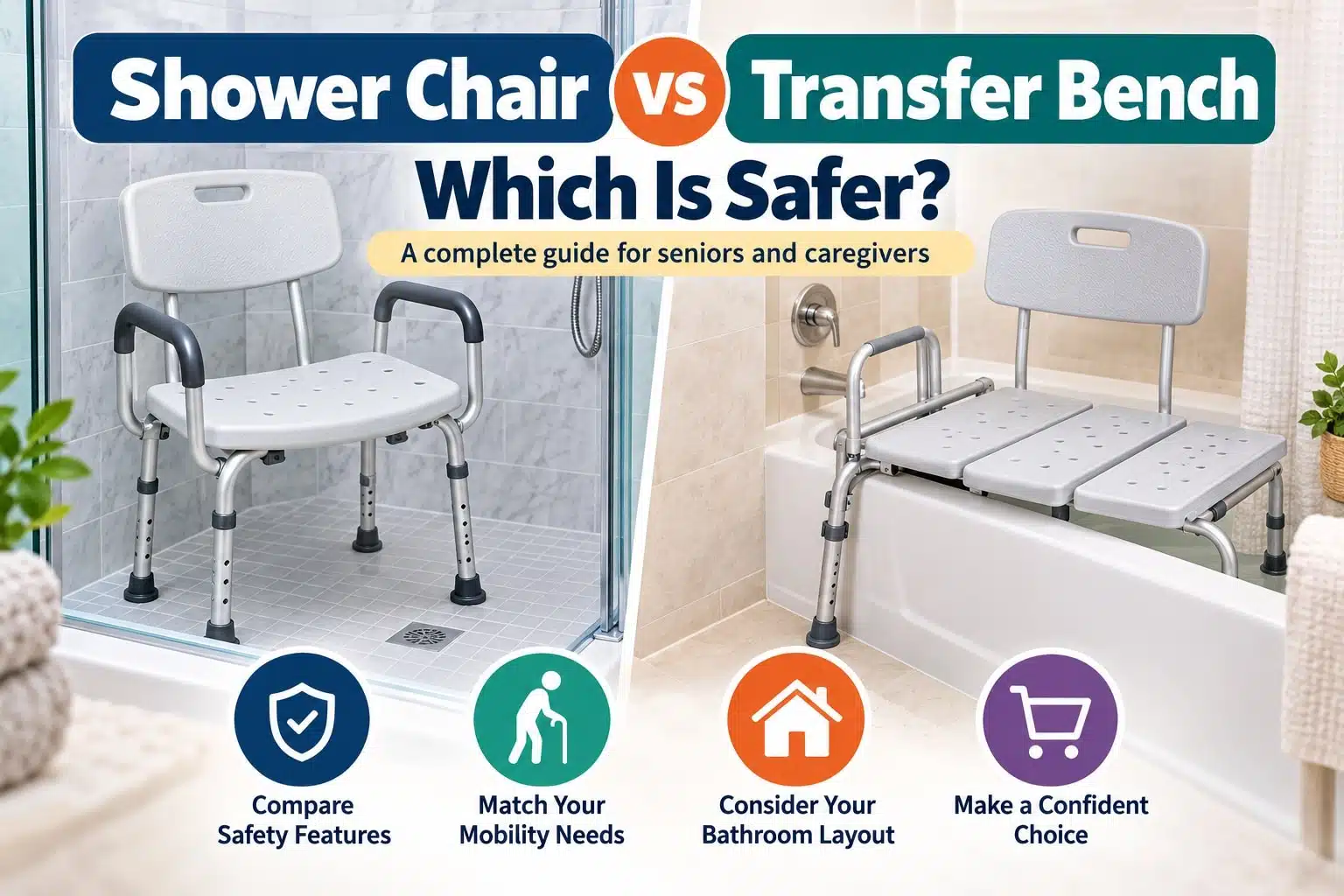
A shower chair helps someone remain seated while washing. A bathtub transfer bench helps someone enter and leave a bathtub without having to step over the high tub wall.
So, which is safer for seniors?
The answer depends on your mobility, bathroom layout and ability to move between sitting and standing positions.
A shower chair may work well in a walk-in shower, while a transfer bench often makes more sense for someone who struggles to lift their legs over a bathtub edge.
Neither device guarantees protection against falls. The safest choice is equipment that fits your bathroom, supports your body and allows you to bathe without making movements you cannot manage safely.
This guide explains the differences, compares safety features and helps seniors and caregivers choose suitable bathing equipment.
Shower Chair vs Transfer Bench: What’s the Difference?
Although shower chairs and bathtub transfer benches look similar, their designs serve different purposes.
What Is a Shower Chair?
A shower chair is a water-resistant seat designed to provide support while bathing. Most models have four legs with rubber feet, drainage holes and adjustable seat heights.
Some include backrests and armrests for additional support.
Shower chairs are commonly used in walk-in showers, although certain models are suitable for bathtubs.
They are particularly useful for people who experience fatigue, arthritis, weak legs or difficulty standing for long periods.
The main limitation is that a standard shower chair does not help someone cross a bathtub wall.
If you use one inside a traditional bathtub, you generally need to enter the tub before sitting down.
For someone with poor balance, that step can present a serious fall risk.
What Is a Transfer Bench?
A bathtub transfer bench is a longer bathing seat designed to span the side of a bathtub.
Typically, two legs stand outside the bathtub and two stand inside. The seat extends across the bathtub wall, allowing the user to sit down outside the tub before moving across into the bathing area.
Rather than lifting one leg over the bathtub while standing, the person can remain seated and move their legs into the tub.
Transfer benches come in several designs:
- Standard transfer benches with fixed seats.
- Sliding transfer benches with seats that move along a track.
- Swivel transfer benches with rotating seats.
- Padded transfer benches designed for additional comfort.
Some models include backrests, armrests, safety belts or handles.
A transfer bench can be particularly helpful for seniors with restricted hip movement, poor balance or difficulty stepping over a bathtub.
However, users still need enough sitting balance, strength or assistance to complete the transfer safely.
Which Is Safer: A Shower Chair or Transfer Bench?
For someone who can safely enter a walk-in shower but struggles to stand while washing, a shower chair is often the more practical choice.
For someone who cannot safely step over a bathtub wall, a transfer bench generally offers a safer way to enter the tub.
The key difference is how each device addresses the risk of falling.
Shower Chair Safety
A shower chair reduces the amount of time someone needs to stand on a wet surface.
This can help people who experience fatigue, leg weakness or dizziness while bathing.
However, the user must still enter the shower or bathtub safely and sit down without losing balance.
A chair does not eliminate the risks associated with stepping over a bathtub wall.
Transfer Bench Safety
A transfer bench reduces the need to stand while crossing a bathtub wall.
This can be especially valuable for seniors who struggle to lift their legs or cannot balance safely on one foot.
However, the user must still move across the seat, position their legs correctly and maintain adequate sitting balance.
A poorly fitted bench, incorrect installation or unsafe transfer technique can create additional hazards.
The safest option depends on which movement presents the greatest difficulty: entering the bathing area or remaining standing while washing.
Shower Chair vs Transfer Bench: Quick Comparison
| Feature | Shower Chair | Transfer Bench |
|---|---|---|
| Primary purpose | Seated bathing | Seated bathing and bathtub entry |
| Typical placement | Inside shower or bathtub | Spans bathtub wall |
| Stepping over bathtub | Usually required | Often avoided |
| Space requirements | Generally compact | Requires more room |
| Walk-in shower | Usually suitable | Usually unnecessary |
| Traditional bathtub | Suitable for some users | Often better for difficult tub entry |
| Balance problems | Supports seated washing | Reduces standing during tub entry |
| Wheelchair transfers | Depends on access and ability | May support lateral transfers |
| Installation | Usually freestanding | Requires careful positioning |
| Main safety concern | Entering and leaving bathing area | Stability and safe transfers |
| Best suited for | People who can enter safely | People who struggle to cross the tub wall |
The table provides a general comparison. Individual products vary in dimensions, weight limits, leg adjustment and supported transfer methods.
When Is a Shower Chair the Better Choice?
A shower chair is often the better choice when entering the bathing area is manageable but standing throughout a shower is difficult.
1. You Have a Walk-In Shower
A walk-in shower with a low threshold or level entrance often works well with a shower chair.
The user can enter the shower, turn carefully and sit down.
For seniors who can walk short distances safely, this arrangement may provide sufficient support without requiring a larger transfer bench.
2. You Experience Fatigue While Bathing
Standing for several minutes can be tiring for people with reduced stamina, arthritis or muscle weakness.
A shower chair allows the user to wash while seated, reducing the physical demands of bathing.
A backrest and armrests may provide additional comfort and support, provided the chair fits and the user can transfer safely.
3. You Have Limited Bathroom Space
Shower chairs are generally more compact than transfer benches.
Some models have narrow frames, removable backrests or smaller seats suitable for restricted shower areas.
A compact shower stool may save more space, but the lack of a backrest and armrests can make the stool unsuitable for someone who needs additional support.
4. You Can Sit Down and Stand Up Safely
A shower chair works best when the user can transfer onto and off the seat without unsafe movements.
Some seniors benefit from properly positioned grab bars or assistance from a caregiver.
If standing up from a low seat is difficult, choose an adjustable-height chair and have the correct height assessed.
For help choosing a suitable design, see our guide to shower chairs for seniors with limited mobility.
When Is a Transfer Bench the Better Choice?
A transfer bench is often more suitable when stepping over a bathtub wall presents a significant fall risk.
1. You Cannot Safely Step Over the Bathtub
Traditional bathtubs have raised sides that require users to lift their legs while maintaining balance.
For seniors with weak legs, arthritis or limited hip movement, this movement can be difficult.
A transfer bench allows the person to sit outside the tub and move across while seated.
This reduces the need to balance on one foot when entering or leaving the bathtub.
2. You Have Restricted Hip or Knee Movement
Some people struggle to lift their legs high enough to cross a bathtub wall.
A transfer bench allows the user to bring their legs into the bathtub while seated, often one at a time.
This may be useful for people with arthritis, restricted joint movement or reduced flexibility.
However, users recovering from hip or knee surgery must follow their surgeon’s movement and weight-bearing instructions.
A transfer bench does not automatically make every transfer safe after surgery.
3. You Need Assistance From a Caregiver
A transfer bench may make bathing assistance more manageable because the user can sit before entering the bathtub.
A caregiver may help guide the user’s legs or supervise movement across the seat.
However, caregivers should avoid manually lifting someone without appropriate training and equipment.
If a person needs substantial physical assistance, an occupational therapist can recommend safer transfer methods.
4. You Use a Wheelchair
Some wheelchair users can transfer laterally from a wheelchair onto a bathtub transfer bench.
The wheelchair must be positioned correctly, its brakes secured and any necessary transfer equipment used according to professional guidance.
A sliding transfer bench may reduce the amount of sideways movement required.
However, not every wheelchair user can safely use a transfer bench, particularly when sitting balance or upper-body strength is limited.
For a closer look at different designs, read our best transfer benches for seniors buying guide.
Which Is Better for Seniors With Balance Problems?
For seniors with poor balance, the safest bathing equipment depends on when the balance difficulty occurs.
Someone who becomes unsteady while standing in the shower may benefit from a shower chair.
Someone who loses balance while lifting a leg over the bathtub wall may benefit more from a transfer bench.
Consider these situations.
Poor Balance While Standing
A shower chair with a supportive backrest and appropriately positioned armrests may help reduce standing time.
The person must still be able to sit down and stand up safely.
Poor Balance When Stepping Over a Bathtub
A transfer bench can reduce the need to balance on one foot.
The user sits before moving into the bathtub, which may make the entry process more manageable.
Poor Sitting Balance
Neither a standard shower chair nor a standard transfer bench may provide enough support for someone who cannot remain upright safely while seated.
A specialist shower or commode chair, additional positioning supports or assisted bathing equipment may be necessary.
An occupational therapist can assess the person’s abilities and recommend appropriate equipment.
Frequent Falls or Severe Weakness
If someone experiences repeated falls, sudden weakness or significant difficulty transferring, choosing equipment without a professional assessment may increase their risk.
A healthcare professional should evaluate the underlying problem and recommend a safe bathing arrangement.
For additional precautions, read our guide on how to prevent slips and falls in the bathroom.
Which Is Better for Wheelchair Users?
For wheelchair users, the comparison between a shower chair and transfer bench involves more than the seat design.
The main consideration is how someone transfers from their wheelchair into the bathing area.
Shower Chairs for Wheelchair Users
A standard shower chair may work when the user can safely stand, take a few steps or complete a supported transfer.
However, standard shower chairs are not always suitable for lateral wheelchair transfers.
A roll-in shower may require a specialist shower wheelchair, roll-in shower chair or wall-mounted shower seat.
The equipment must match the user’s transfer abilities and bathroom design.
Transfer Benches for Wheelchair Users
A bathtub transfer bench may provide a practical solution when a wheelchair user has a traditional bathtub.
Some users can position their wheelchair alongside the bench and move sideways onto the seat.
Sliding models may reduce the physical effort needed to move across the bathtub wall.
Before choosing one, check:
- Whether the wheelchair can approach the bench closely enough.
- Whether there is sufficient space for the wheelchair and caregiver.
- Whether the user has adequate sitting balance.
- Whether the bench supports the user’s weight.
- Whether the transfer method is safe for the user’s abilities.
- Whether the bathtub and floor allow stable installation.
A transfer bench should not be treated as a substitute for a mechanical lift or other specialist equipment when someone cannot transfer safely.
Shower Chair vs Transfer Bench for Small Bathrooms
Bathroom size can influence which bathing aid is practical.
A standard shower chair generally occupies less space than a bathtub transfer bench.
Transfer benches need room both inside and outside the bathtub, which can create problems in narrow bathrooms.
Shower Chairs for Narrow Shower Stalls
Compact shower chairs and stools may fit inside smaller shower enclosures.
Before buying, check that the legs fit completely on a suitable, stable surface and that the seat does not block the shower door.
Avoid choosing a very small stool solely to save space if the user needs a backrest or armrests.
Transfer Benches for Narrow Bathtubs
A transfer bench needs enough space for its inside legs, outside legs and seat.
The bathroom must also provide sufficient clearance for sitting down and moving across the bench.
A nearby toilet, vanity unit or cabinet may prevent proper positioning.
Some transfer benches offer adjustable widths or alternative configurations, but they still need to meet the manufacturer’s installation requirements.
What About Folding Bathing Equipment?
Folding shower seats and certain compact transfer benches may help in restricted bathrooms.
However, folding mechanisms must lock securely before use.
Wall-mounted shower seats require appropriate structural support and installation.
If space is limited, read our guide to making a small bathroom accessible for seniors.
Essential Safety Features to Look For
Whether you choose a shower chair or bathtub transfer bench, several features deserve attention.
Non-Slip Feet
Rubber or other slip-resistant feet help keep freestanding bathing equipment stable.
Check that every foot makes secure contact with the floor or bathtub surface.
Replace worn or damaged feet according to the manufacturer’s instructions.
Adjustable Seat Height
Adjustable legs allow the seat height to match the user’s needs.
A seat that is too low may make standing difficult, while one that is too high may leave the feet unsupported.
For transfer benches, the inside and outside legs may need different height settings to account for the bathtub floor and bathroom floor.
Follow the manufacturer’s instructions for adjustment and leveling.
Backrests and Armrests
Backrests may provide additional support while seated.
Armrests can assist with positioning and certain transfers, but only when the manufacturer permits their use for that purpose.
Some transfer benches have removable or reversible backrests to accommodate different bathtub arrangements.
Weight Capacity
Every shower chair and transfer bench has a maximum user weight specified by the manufacturer.
Choose equipment with an appropriate capacity and never exceed the stated limit.
Also check whether the manufacturer’s capacity rating applies to all configurations and accessories.
Drainage Holes
Drainage holes help prevent water from collecting on the seat.
A textured seating surface may also help reduce slipping while seated.
Stable Frame Construction
Look for a frame that feels secure and does not rock when correctly positioned.
For transfer benches, confirm that the legs, seat, backrest and any sliding mechanisms are fully secured before use.
Sliding and Swivel Mechanisms
Sliding transfer benches allow the seat to move along a frame, while swivel models allow the seat to rotate.
These features may reduce the effort required for certain transfers.
However, moving seats introduce additional considerations, including locking mechanisms, pinch points and safe positioning.
Choose a design based on the user’s physical abilities rather than assuming more moving features mean greater safety.
How to Measure Your Bathroom Before Buying
One of the most common mistakes when choosing shower safety equipment is checking the seat dimensions without measuring the surrounding bathroom.
A chair or bench may fit inside the bathtub but still leave insufficient room for safe transfers.
Measuring for a Shower Chair
Measure the usable width and depth of your shower floor.
Check the distance between any shower doors, walls and fixed fixtures.
Then compare those measurements with the chair’s full footprint, including the legs.
Allow enough space for the user to sit, stand and move without striking nearby fixtures.
Check that the chair’s feet will rest on suitable, stable surfaces.
For detailed instructions, see how to measure your shower for a shower chair.
Measuring for a Transfer Bench
Transfer benches require several additional measurements.
Measure the following:
- Bathtub wall height, from the bathroom floor to the top of the tub wall.
- Bathtub interior width, including the usable flat area for the inside legs.
- Clearance outside the bathtub for the outside legs and seating area.
- Distance to nearby toilets, cabinets and other obstructions.
- Space available for a wheelchair or caregiver, when applicable.
- User’s seated height and transfer requirements.
Check whether the bathtub has a curved base, raised floor, unusually thick wall or other features that may affect the bench’s fit.
A bench should never be forced into a space where the legs cannot be positioned securely.
Common Shower Chair and Transfer Bench Safety Mistakes
Even suitable equipment can become unsafe when used incorrectly.
1. Placing Equipment on an Unstable Surface
All legs must contact appropriate surfaces as specified by the manufacturer.
A chair or bench that rocks, slides or shifts should not be used until the problem is corrected.
2. Choosing the Wrong Seat Height
Incorrect seat height can make sitting, standing and transferring more difficult.
Adjust the equipment to suit the user and confirm that every adjustment mechanism is locked.
3. Using a Shower Chair to Avoid a Difficult Bathtub Transfer
A standard shower chair does not remove the need to cross the bathtub wall.
Someone who cannot safely step over the tub should not assume that placing a chair inside will solve the problem.
4. Pulling on Equipment Not Designed for Support
Some people grab the backrest or armrest to pull themselves upright.
Not every bathing chair or bench is designed to withstand these forces.
Use only the support points approved by the manufacturer.
Properly installed grab bars may provide additional support when positioned for the user’s needs.
5. Ignoring Weight Limits
Using equipment beyond its rated capacity can damage the frame or compromise stability.
Always check the manufacturer’s specifications.
6. Leaving the Bathroom Floor Wet
Water outside the shower or bathtub creates an additional slipping hazard.
Keep transfer areas as dry as practical and address leaks or drainage problems.
7. Using Damaged Equipment
Loose bolts, cracked seats, worn rubber feet and faulty locking mechanisms can affect safety.
Inspect equipment regularly and replace damaged components according to manufacturer guidance.
8. Attempting Transfers Without Enough Support
A person who needs help moving between surfaces should not attempt an unsupported transfer simply because a bench is available.
Professional assessment and caregiver training may be necessary.
For more ways to improve bathroom safety, read our bathroom safety tips for seniors.
Shower Chair vs Transfer Bench: How to Choose
The following checklist can help you identify which type of equipment deserves closer consideration.
| Your Situation | Equipment to Consider |
|---|---|
| You have a walk-in shower and tire easily | Shower chair |
| You can enter the shower safely but cannot stand for long | Shower chair |
| You struggle to step over a bathtub wall | Transfer bench |
| You have arthritis that restricts leg movement | Transfer bench if tub entry is difficult |
| You use a wheelchair and have a traditional bathtub | Transfer bench after transfer assessment |
| You have a narrow shower stall | Compact shower chair, if suitable |
| You need help moving sideways across the tub | Sliding transfer bench after assessment |
| You have poor sitting balance | Specialist bathing equipment and professional assessment |
| You cannot transfer safely without substantial assistance | Professional assessment for assisted bathing equipment |
This checklist is a starting point rather than a substitute for individual assessment.
The safest equipment should match both the bathroom and the person using the equipment.
Frequently Asked Questions
Is a transfer bench safer than a shower chair for seniors?
A transfer bench is often safer for someone who has difficulty stepping over a bathtub wall. The person can sit before moving into the bathtub, reducing the need to balance on one foot.
A shower chair may be more suitable for someone who can safely enter a walk-in shower but needs support while washing.
Neither option is universally safer.
Can a shower chair be used inside a bathtub?
Yes. Some shower chairs are designed for bathtub use.
However, the chair must fit securely on the bathtub floor and meet the manufacturer’s requirements.
A standard shower chair does not help someone cross the bathtub wall.
If entering the bathtub is difficult, a transfer bench may be more appropriate.
Do transfer benches prevent bathroom falls?
Transfer benches can reduce certain fall risks, particularly those associated with stepping over a bathtub wall.
However, they cannot eliminate falls.
The bench must fit correctly, remain stable and support safe transfers.
The CDC’s fall prevention guidance also recommends properly installed grab bars and removing household trip hazards.
Can wheelchair users use a transfer bench independently?
Some wheelchair users can transfer independently when they have sufficient sitting balance, upper-body strength and an appropriate bathroom layout.
Others require assistance, specialist transfer equipment or a different bathing arrangement.
An occupational therapist can assess whether independent transfers are safe.
What is the safest bathing aid for someone with poor balance?
For someone who can safely enter a walk-in shower, a shower chair with appropriate support may be suitable.
For someone who struggles to step over a bathtub wall, a transfer bench may reduce the risk associated with entering the tub.
People with significant sitting balance problems may need specialist equipment.
Are sliding transfer benches safer than standard benches?
Sliding transfer benches can reduce the amount of sideways movement needed to enter a bathtub.
They may be helpful for people with limited mobility or reduced upper-body strength.
However, sliding mechanisms must operate correctly and lock securely where required.
A standard transfer bench may be more appropriate for someone who can move across the seat safely without additional mechanisms.
Does Medicare cover shower chairs or transfer benches?
Original Medicare generally does not cover standard shower chairs or bathtub transfer benches because they are usually classified as bathroom safety equipment rather than covered durable medical equipment.
Some Medicare Advantage plans may offer supplemental benefits for bathroom safety equipment.
Coverage depends on the specific plan, equipment and eligibility requirements.
Before purchasing, check your plan’s benefits or contact your insurance provider.
For more information, see Medicare’s official durable medical equipment coverage guidance.
Final Verdict: Shower Chair or Transfer Bench?
The safest choice depends on your mobility and how you enter the bathing area.
A shower chair is generally a practical option for seniors who can enter a walk-in shower safely but need somewhere to sit while washing.
A bathtub transfer bench is often more appropriate for people who struggle to step over a bathtub wall, particularly those with weak legs, restricted joint movement or balance difficulties.
Before making a decision, measure your bathroom, check the equipment’s weight capacity and consider whether you can transfer safely.
If you have experienced falls, need physical assistance or are recovering from surgery, speak with an occupational therapist before choosing equipment.
The right bathing aid should make everyday washing more manageable without introducing new safety risks.
Additional Safety Resources
For further guidance on choosing and using bathing equipment, these resources provide practical information:
- Memorial Sloan Kettering Cancer Center: Shower and Bathtub Accessories. Explains how shower chairs and transfer benches work.
- CDC: Preventing Falls and Hip Fractures. Covers fall prevention and bathroom safety.
- Medline: Bathtub Transfer Bench Features. Provides examples of adjustable seating, backrests and stability features.
- Medicare: Durable Medical Equipment Coverage. Explains Medicare’s equipment coverage requirements.