

Finding the best electric jar opener for arthritis can make cooking less frustrating when stiff fingers, painful joints, or weak hands make opening food jars difficult.
I’ve researched five electric jar openers for seniors and adults with limited grip strength, focusing on their operating mechanisms, accessibility features, manufacturer information, and practical limitations.
My main concern is how much work the opener actually removes. A motor that twists the lid is useful, but less so if you still need a strong grip to hold the jar steady.
As an Amazon Associate, we earn from qualifying purchases.
Quick Comparison: 5 Electric Jar Openers
| Product | Best for | Weight | Price tier |
|---|---|---|---|
| RoboTwist Deluxe | Everyday jar opening | Not verified | Budget to mid-range |
| Hamilton Beach OpenEase 76800 | Simple controls | Not verified | Availability varies |
| INSTACAN Rechargeable | Rechargeable convenience | Not verified | Mid-range |
| Besmon Electric Jar Opener | Standard glass jars | Not verified | Budget |
| BLACK+DECKER Lids Off JW200 | Countertop jar support | Approx. 3.5 lb | Resale pricing varies |
How to Choose an Electric Jar Opener for Arthritis
An automatic jar opener should reduce the gripping and twisting movements that make opening jars uncomfortable.
But there’s a difference between loosening a lid automatically and handling the entire jar without assistance.
For someone with arthritis, the following details matter more than the number of features advertised.
One-touch operation
I’d prioritize a one-touch electric jar opener with a large, easy-to-press button.
Many compact models use motorized arms that close around the jar and lid. Once activated, the motor applies the twisting force needed to loosen the lid.
That removes much of the strain from your fingers and wrist.
Check whether you need to hold the button throughout the opening cycle. A model that runs automatically after one press may be easier for someone with painful finger joints.
Jar stability and grip strength
This is probably the most overlooked buying consideration.
Some electric jar openers grip the lid but still require you to hold the jar steady.
If you have severe rheumatoid arthritis, hand tremors, or weakness in both hands, that may be difficult.
A countertop opener with a built-in jar support can be a better option.
I’d also check whether the gripping arms have protective surfaces that reduce slipping or scratching.
Compatible jar and lid sizes
Don’t assume an electric jar opener works with every container.
Most compact models are designed around common glass food jars with metal screw-top lids.
Some won’t accommodate very small lids, oversized jars, or plastic containers.
Before buying, check the manufacturer’s stated minimum and maximum lid diameters.
Think about the containers you open most often. A device that opens pasta sauce jars but can’t handle your regular peanut butter container may disappoint.
Batteries or rechargeable power
Battery-operated jar openers are convenient because they don’t need a power outlet.
The drawback is changing batteries.
Small battery covers can be awkward for someone with stiff fingers.
Rechargeable models avoid frequent battery replacement, although plugging in a charging cable may present another difficulty.
I’d choose whichever power arrangement is easiest for the person using the opener.
Cleaning and storage
A compact electric jar opener can usually fit into a kitchen drawer.
Larger countertop models take up more space but may be easier to use when left permanently accessible.
Most motorized openers aren’t dishwasher safe. Look for a design that allows you to wipe the exterior and gripping arms without dismantling the mechanism.
If you’re buying for an older parent, consider where they’ll keep the opener. A kitchen aid isn’t particularly useful if retrieving it from a high cupboard causes more difficulty than opening the jar.
Best Kitchen Gadgets for Seniors With Arthritis
RoboTwist Deluxe Automatic Jar Opener: Best for Everyday Use
The RoboTwist Deluxe is my first choice for someone who regularly struggles with tight jar lids.
Deluxe Model with Improved Torque | Electric, One Touch Hands Free for Seniors with Arthritis or Weak Hands, Fits All Jars 1.2 3.5 in
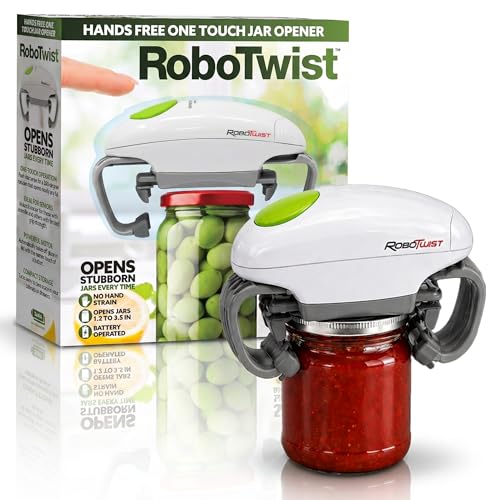
This battery-operated jar opener uses motorized gripping arms to hold the jar and turn the lid. The main attraction is that you don’t have to supply the twisting force yourself.
The Deluxe version is marketed as having a stronger motor than the original RoboTwist, although I’d still check the exact model before ordering.
What works
I like the straightforward design. You position the opener over the jar, press the activation button, and allow the motor to loosen the lid.
For someone with osteoarthritis in their hands, avoiding that twisting movement is a useful benefit.
The adjustable gripping arms also make the design more practical than an opener built for one fixed lid size.
It’s compact enough to store in a drawer, which is helpful if you have limited counter space.
What doesn’t
The jar must remain stable while the opener operates. Someone with severe hand weakness may still struggle to keep the container from moving.
The opening process also takes longer than twisting off a lid manually.
Another consideration is battery replacement. Opening the battery compartment may be awkward for someone with stiff fingers.
Who it suits
I’d recommend the RoboTwist Deluxe for older adults with mild to moderate arthritis who can position the opener and steady a jar.
It’s the model I’d compare first for everyday kitchen use.
Hamilton Beach OpenEase 76800: Best for Simple Controls
The Hamilton Beach OpenEase 76800 was specifically designed to help people with arthritis or limited hand dexterity.
Simply place the jar opener on top of the jar and press the engage button. Compact for easy storage in a drawer or cabinet. Opens a wide variety of jar sizes-no jar is too tall

According to Hamilton Beach, the company consulted people with dexterity difficulties during development.
What caught my attention was the separate opening and release controls. That makes the operating process easier to understand.
What works
The OpenEase handles glass jars with screw-top lids measuring between 1 and 4 inches in diameter.
It runs on two AA batteries. Hamilton Beach states that a set of batteries can open more than 250 jars.
You place the opener over the jar and press the opening button. The outer arms grip the jar while the inner arms tighten around the lid and rotate.
Once the lid loosens, a separate button releases the gripping arms.
I particularly like that the manufacturer clearly explains the operating sequence.
What doesn’t
The biggest drawback is availability.
Hamilton Beach currently identifies this model as no longer available on its official website. Remaining stock or resale listings may be difficult to find.
The manufacturer also advises against using it with plastic jars.
For tapered jars, you may need to hold the opener firmly in place.
Who it suits
I’d consider the OpenEase for someone who prefers clearly labeled buttons and mainly opens standard glass food jars.
I wouldn’t pay a premium for an older model without checking the seller’s return policy.
INSTACAN Rechargeable Electric Jar Opener: Best for Rechargeable Convenience
The INSTACAN rechargeable electric jar opener is worth investigating if you prefer kitchen gadgets that don’t need disposable batteries.
Easy Remove Almost Size Lid with Auto-Off, Powerful Bottle Opener for Arthritic Hands, Automatic Jar Opener for Weak Hands and Seniors

Rechargeable appliances appeal to me for one practical reason. Replacing small batteries can be difficult when your fingers are painful or stiff.
A rechargeable opener avoids that particular job.
What works
The advertised rechargeable design removes the need to keep spare batteries in the kitchen.
Its automatic opening mechanism is intended to loosen lids without requiring the user to twist them manually.
For someone who opens jars frequently, that arrangement may be convenient.
I also prefer cordless appliances for kitchen accessibility because there’s no trailing power cable during use.
What doesn’t
Rechargeable doesn’t necessarily mean easier to operate.
Connecting a small charging plug may be difficult for someone with limited finger dexterity.
I’d check the charging connection, button size, and lid compatibility carefully.
I couldn’t independently confirm the current INSTACAN model’s full specifications or reliable owner-review history, so I wouldn’t recommend buying without checking the exact listing.
Who it suits
I’d consider this opener for someone who prefers rechargeable kitchen equipment and can comfortably manage the charging connection.
For severe arthritis, I’d prioritize the gripping mechanism and controls over the rechargeable feature.
Besmon Electric Jar Opener: Best for Standard Glass Jars
The Besmon electric jar opener is another compact design worth comparing for people with painful hands.
Strong Tough Automatic Jar Opener For New Sealed Jars,The Hands Free Jar Opener with Less Effort to Open
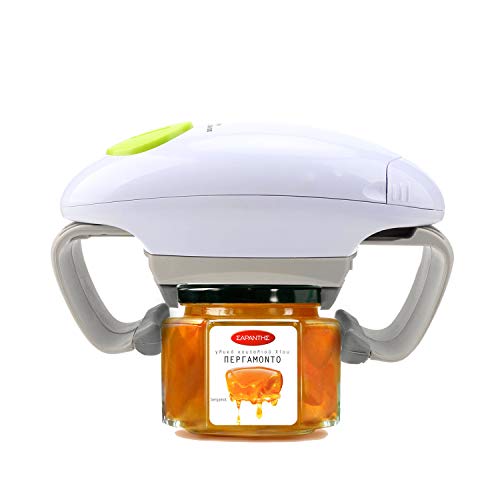
Its advertised motorized gripping mechanism is intended to loosen screw-top lids while reducing the amount of manual twisting required.
I like the idea of a small appliance that handles an awkward kitchen job without taking up permanent counter space.
What works
The advertised automatic operation is the main attraction.
An adjustable gripping mechanism is intended to accommodate different jar and lid sizes.
That makes the design worth considering for everyday containers such as jam jars and pasta sauce jars.
A compact opener may also suit older adults living in apartments with limited kitchen storage.
What doesn’t
I’d pay particular attention to the lid-size restrictions.
Some compact electric openers aren’t suitable for plastic lids, unusually shaped containers, or very small jars.
I couldn’t independently verify the current Besmon model’s full specifications, so those details need checking against the seller’s instructions.
The jar may also require stabilizing while the motor operates.
Who it suits
I’d compare Besmon with RoboTwist for someone who mainly opens ordinary glass food jars and wants a compact battery-operated opener.
If you’re buying for someone with severe hand weakness, I’d favor a model with better-documented support and operating instructions.
BLACK+DECKER Lids Off JW200: Best for Countertop Support
The BLACK+DECKER Lids Off JW200 is quite different from the compact automatic jar openers.
Electric jar opener that easily releases vacuum-sealed lids. Simple operation, adjustable height, and large release button
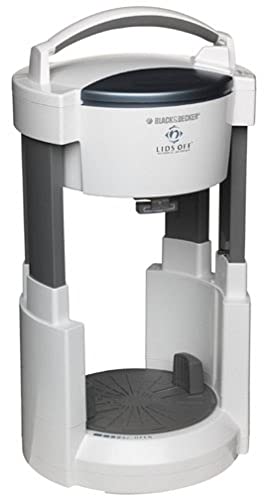
Instead of placing a small appliance on top of a jar, you put the jar inside a countertop machine.
The unit grips the container from below while its upper mechanism loosens the lid.
For someone who struggles to hold a jar steady, that design deserves attention.
What works
The built-in jar supports are the biggest advantage.
According to the operating manual, the lower supports secure the jar while the upper jaws grip and turn the lid.
That reduces the need to stabilize the container manually.
The machine also operates from a household electrical outlet, so there are no batteries to replace.
I particularly like the separate support for the jar itself. That’s a practical distinction for people with limited grip strength.
What doesn’t
The appliance takes up more counter space than a portable opener.
Its operation also involves several steps. You need to raise the upper section, position the jar, lower the mechanism, and hold the operating button.
Someone with severe hand mobility problems may find those adjustments awkward.
The JW200 is also an older model, so availability and replacement support may be limited.
Who it suits
I’d consider the JW200 for someone who has difficulty stabilizing jars and has room to leave the appliance on a kitchen counter.
It’s also worth considering for people with hand tremors, provided they can operate the controls safely.
Which One Should You Buy?
The best jar opener for seniors with arthritis depends on how much grip strength they have and whether they can hold a container steady.
I wouldn’t choose purely on price.
A cheaper opener that requires uncomfortable hand movements may end up unused.
Best for mild to moderate arthritis
I’d start with the RoboTwist Deluxe.
Its compact motorized design addresses the twisting motion that makes jar opening difficult for many people with arthritis.
It’s a reasonable choice if you can position the opener and keep the jar stable.
Best for severe hand weakness
I’d investigate the BLACK+DECKER JW200.
Its supported countertop design reduces the need to grip the jar while the lid loosens.
The trade-off is a larger appliance and a more involved operating sequence.
Best for people who prefer simple controls
The Hamilton Beach OpenEase has clearly documented opening and release buttons.
Its main disadvantage is limited availability.
I’d check the condition and seller before buying an older unit.
Best for rechargeable convenience
I’d compare the INSTACAN with other rechargeable models.
The charging connection should be easy to reach, and the lid-size range should match your usual food containers.
Best for a tight budget
I’d compare current Besmon and RoboTwist listings.
Look at the return policy, compatibility information, and recent customer feedback rather than choosing the lowest advertised price.
9 Best Kitchen Gadgets for Seniors With Arthritis
Electric vs Manual Jar Openers for Arthritis
An electric jar opener isn’t always necessary.
For someone with mild arthritis, a rubber grip pad or manual jar opener may provide enough extra leverage.
But if gripping and twisting cause regular discomfort, an automatic opener is worth considering.
| Feature | Electric jar opener | Manual jar opener |
|---|---|---|
| Twisting effort | Motor provides force | User supplies force |
| Grip strength | Usually less required | Depends on design |
| Power | Batteries or electricity | None |
| Storage | Compact to countertop | Usually compact |
| Maintenance | Batteries or charging | Minimal |
| Best for | Weak grip and painful twisting | Mild grip difficulties |
Are rubber grip openers enough?
A rubber grip pad improves friction between your hand and the lid.
That helps prevent slipping, but you still need to twist.
For someone with painful wrist or finger joints, that movement may remain uncomfortable.
What about under-cabinet jar openers?
An under-cabinet opener provides a fixed gripping surface.
You position the lid against the gripping mechanism and turn the jar.
This may help someone who has difficulty holding a lid, but it still requires wrist and arm movement.
I’d consider one for mild grip problems rather than severe hand weakness.
Are electric jar openers suitable for one-handed use?
Some automatic designs reduce the need to use both hands, particularly countertop models that secure the jar.
But I wouldn’t assume a product supports independent one-handed operation unless its manufacturer specifically confirms that.
Someone with use of only one hand should pay close attention to positioning, controls, and jar removal.
Are Electric Jar Openers Worth It for Seniors?
I think an electric jar opener is worth considering if opening food jars regularly causes pain or requires assistance.
The main benefit is reducing the force needed to loosen a lid.
For people with osteoarthritis or rheumatoid arthritis affecting their hands, avoiding repeated forceful gripping may make everyday kitchen tasks more manageable.
But there’s a catch.
An automatic opener still needs to be positioned, activated, and removed. Some models require the jar to be held steady.
Before buying, I’d consider the entire process rather than concentrating only on the motor.
Can you lift the appliance comfortably? Can you reach the controls? Can you remove the loosened lid afterward?
Those questions help identify which design will actually be useful.
The Arthritis Foundation provides information about joint protection, everyday activities, and assistive equipment for people living with arthritis.
For someone with substantial hand difficulties, an occupational therapist can help identify kitchen aids that match their movement and strength.
[INTERNAL LINK: How to Make Your Kitchen Safer for Aging in Place]
Common Questions
What is the best electric jar opener for arthritis?
I’d start by comparing the RoboTwist Deluxe because its motorized gripping mechanism reduces the need to twist lids manually. For someone who cannot hold a jar steady, a supported countertop design may be more suitable.
Do electric jar openers work on vacuum-sealed jars?
Many automatic jar openers are designed to loosen screw-top lids on vacuum-sealed glass food jars. Performance depends on the jar, lid size, gripping mechanism, and motor, so check the manufacturer’s stated compatibility.
Can someone with rheumatoid arthritis use an automatic jar opener?
An automatic opener may reduce the gripping and twisting movements that cause discomfort for someone with rheumatoid arthritis. The best design depends on finger movement, hand strength, and whether the user can stabilize the container.
Are electric jar openers better than manual ones for weak hands?
Electric models generally require less twisting force because a motor loosens the lid. Manual openers are simpler and usually cheaper, but many still require some grip strength.
Can electric jar openers open plastic lids?
Some models are intended only for metal screw-top lids on glass jars. Check the manufacturer’s instructions before attempting to open plastic containers or unusually shaped lids.
My Final Recommendation
For most seniors with arthritis, I’d start with the RoboTwist Deluxe because of its compact design and motorized opening mechanism.
If holding the jar steady is the bigger problem, the BLACK+DECKER JW200’s supported countertop design deserves consideration.
The Hamilton Beach OpenEase is another interesting option because of its simple controls and documented lid compatibility, although availability is a concern.
Whichever model you choose, I’d check the lid-size range and operating instructions before ordering.
The best electric jar opener for arthritis is the one that removes the movements you find difficult, without introducing a new set of awkward tasks.